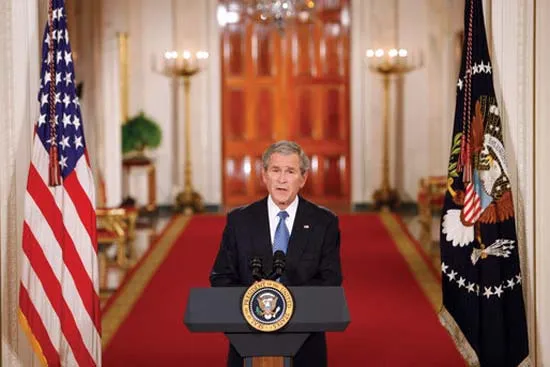
isess2013.org – George W. Bush, the 43rd president of the United States, served two terms from January 2001 to January 2009. His presidency was marked by major events that reshaped the U.S. and global politics, including the 9/11 terrorist attacks, the wars in Afghanistan and Iraq, and the global financial crisis. Bush’s leadership style and decisions, particularly in foreign policy, left a lasting impact on America’s role in the world and its domestic affairs. His presidency is remembered for its focus on security, economic challenges, and efforts to promote democracy abroad.
Early Political Career and Rise to the Presidency
Before his presidency, George W. Bush served as the governor of Texas from 1995 to 2000. His political career followed a successful business background in the oil industry and partial ownership of the Texas Rangers baseball team. As the son of former president George H. W. Bush, he entered national politics with both name recognition and strong political connections.
Bush ran for the presidency in 2000 as a Republican candidate, advocating for limited government, tax cuts, and compassionate conservatism. The 2000 election was one of the most contested in U.S. history, culminating in a Supreme Court decision that resolved the Florida recount in Bush’s favor. He won the Electoral College, despite losing the popular vote to Democrat Al Gore.
The 9/11 Attacks and the War on Terror
The defining event of Bush’s presidency came early in his first term on September 11, 2001. The terrorist attacks on New York City and Washington, D.C., carried out by al-Qaeda, killed nearly 3,000 people and triggered a profound shift in U.S. foreign policy. Bush responded swiftly, declaring a “War on Terror” and prioritizing national security.
The U.S. invasion of Afghanistan in October 2001 aimed to dismantle al-Qaeda and remove the Taliban regime that had harbored its leadership. This operation, known as Operation Enduring Freedom, was initially successful in toppling the Taliban, though the conflict would continue for many years.
The Iraq War and Controversy
In 2003, Bush expanded the War on Terror by launching the U.S. invasion of Iraq, a decision that became one of the most controversial aspects of his presidency. The Bush administration argued that Iraq, under the dictatorship of Saddam Hussein, possessed weapons of mass destruction (WMDs) and posed a threat to global security. Despite a lack of United Nations support and widespread international opposition, the U.S.-led coalition invaded Iraq in March 2003.
While the invasion led to the swift overthrow of Saddam Hussein, no WMDs were found, leading to criticism of the intelligence and justification for the war. The occupation of Iraq became increasingly challenging as sectarian violence and insurgency took hold. The war claimed the lives of thousands of U.S. soldiers and tens of thousands of Iraqi civilians, and it deeply polarized public opinion in the U.S. and around the world.
Domestic Policy: Tax Cuts and Economic Challenges
On the domestic front, Bush’s presidency began with a focus on tax reform and economic policy. In 2001 and 2003, he signed into law significant tax cuts aimed at stimulating economic growth. These cuts were central to his administration’s economic strategy, though they were criticized by some for disproportionately benefiting the wealthy and contributing to growing budget deficits.
Bush also championed education reform through the No Child Left Behind Act, which aimed to improve educational standards and accountability in public schools. While the legislation received bipartisan support, its implementation faced criticism over its emphasis on standardized testing and its impact on schools in disadvantaged areas.
Hurricane Katrina and the Government’s Response
In August 2005, Hurricane Katrina struck the Gulf Coast, particularly devastating New Orleans and surrounding regions. The Bush administration faced widespread criticism for its slow and ineffective response to the disaster, which left thousands dead, displaced millions, and caused widespread destruction.
The federal government’s handling of the disaster, including the failures of the Federal Emergency Management Agency (FEMA), damaged Bush’s approval ratings and raised questions about the administration’s competence in handling domestic crises.
Second Term and the Global Financial Crisis
Bush won re-election in 2004, defeating Democratic candidate John Kerry in another closely fought contest. His second term was dominated by ongoing conflicts in Iraq and Afghanistan, but it was the 2008 global financial crisis that defined the final year of his presidency.
The collapse of major financial institutions, triggered by the bursting of the U.S. housing bubble and a resulting credit crisis, led to the worst economic downturn since the Great Depression. In response, the Bush administration implemented emergency measures, including the $700 billion Troubled Asset Relief Program (TARP), to stabilize the financial system and prevent further economic collapse. While TARP helped avert a complete meltdown, the crisis left millions of Americans unemployed and deeply affected the U.S. economy for years to come.
Legacy of Foreign Policy
Bush’s foreign policy legacy is defined by the War on Terror, the Iraq War, and his efforts to promote democracy abroad. His administration advocated for the spread of democratic governance, particularly in the Middle East, as part of a broader strategy to combat terrorism and authoritarianism. This policy, often referred to as the Bush Doctrine, was met with mixed success and significant criticism.
The long-term consequences of the Iraq War, in particular, are still debated. While the removal of Saddam Hussein eliminated a brutal dictator, the instability that followed contributed to the rise of extremist groups like ISIS and prolonged conflict in the region.
Conclusion and Post-Presidential Life
George W. Bush left office in January 2009 with low approval ratings, largely due to the Iraq War and the financial crisis. However, in the years since his presidency, public perception of Bush has shifted somewhat, with his personal likability and post-presidential humanitarian work earning him more favorable views.
Bush has remained largely out of the political spotlight, focusing on charitable work, such as advocating for veterans’ issues, education, and global health through the George W. Bush Presidential Center. He has also taken up painting and published several books, reflecting on his presidency and personal experiences.
Ultimately, Bush’s presidency remains a deeply consequential period in American history, with its legacy shaped by both the successes and failures of his leadership during a time of global turmoil and transformation.